If you want to improve your ear, understand harmony more deeply, and transpose jazz standards with ease, the movable-Do solfege system is one of the most powerful tools you can use. Unlike fixed-Do (where “Do” is always C), movable-Do assigns each syllable to a scale degree, making it directly connected to musical function.
This makes it ideal for jazz musicians, who constantly switch keys, learn standards from recordings, and navigate complex modulations.
In this guide, Alex Terrier will teach you:
- what movable-Do solfege is,
- why it works so well for jazz ear training,
- how to apply it to real standards,
- how to use it in minor keys, and
- examples you can practice today.
What Is Movable Do?
Movable-Do solfege is a system where each syllable corresponds to a scale degree rather than a specific pitch. This means that in any major key:
- Do = the tonic
- Re = the second degree
- Mi = the third degree
- Fa = the fourth degree
- So = the fifth degree
- La = the sixth degree
- Ti = the seventh degree
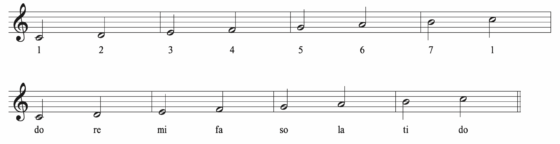
Here are the syllables on the C major scale:
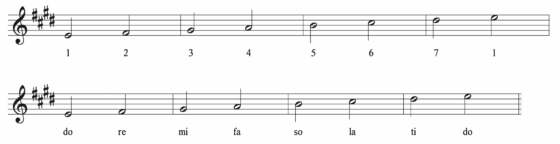
Now in E major:
Because everything is sung in relation to the tonic, the ear learns to identify:
- tonal center,
- intervallic relationships,
- chord–scale connections,
- and the melodic implications of harmony.
This functional hearing is exactly what jazz musicians need.
Movable Do Solfege Table (Major Scale)
Major scale degree | Function | Mova. do solfège syllable | # of half steps from Do |
1 | Tonic | Do | 0 |
Raised 1 | Di | 1 | |
Lowered 2 | Ra | 1 | |
2 | Supertonic | Re | 2 |
Raised 2 | Ri | 3 | |
Lowered 3 | Me (& Ma) | 3 | |
3 | Mediant | Mi | 4 |
4 | Subdominant | Fa | 5 |
Raised 4 | Fi | 6 | |
Lowered 5 | Se | 6 | |
5 | Dominant | Sol | 7 |
Raised 5 | Si | 8 | |
Lowered 6 | Le (& Lo) | 8 | |
6 | Submediant | La | 9 |
Raised 6 | Li | 10 | |
Lowered 7 | Te (& Ta) | 10 | |
7 | Leading tone | Ti | 11 |
Why Movable Do Is Perfect for Jazz
Jazz musicians deal with:
- tunes in multiple keys,
- modulations,
- secondary dominants,
- melodic chromaticism, and
- transposition on the fly.
Movable-Do gives you:
- Instant interval recognition
- A clear understanding of which notes are diatonic or chromatic
- Better ear–hand coordination
- Easier transposition of melodies
- A deeper awareness of functional harmony
If you’ve ever struggled to learn tunes in different keys, movable-Do is one of the fastest solutions.
Start Simple: “C Jam Blues”
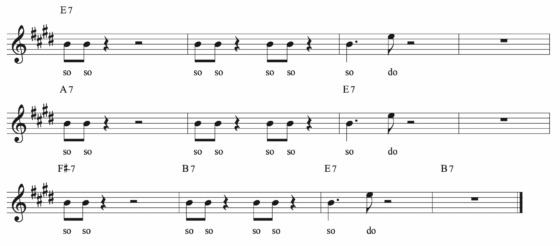
A great beginner exercise is Duke Ellington’s “C Jam Blues”, which contains only two notes.
Try singing:
- So – Do along with the chord progression
- or sing the melody and label the function of each note
Start with simple tunes to use movable-Do to train your ear to understand tonal relationships. The interval So – Do is a perfect fourth ascending, so is Do – Fa. But So – Do is 5 – 1, while Do – Fa is 1 – 4!
Here is “C Jam Blues” in C:

And here “C Jam Blues” in E:
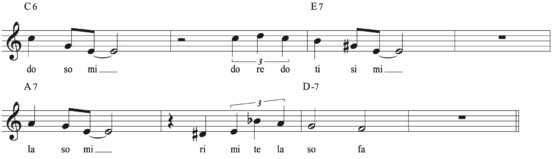
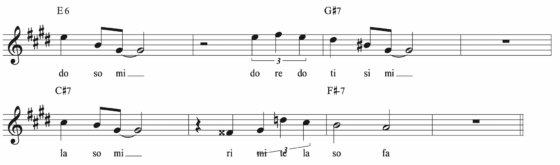
Using Movable Do on Standards: “All of Me”
In “All of Me”, singing the melody with movable-Do makes it easy to hear:
- which notes belong to the key, and
- where foreign notes appear.
This helps you:
- improvise more melodically,
- recognize key centers,
- and internalize the sound of chord changes.
Here is “All Of Me” in C:
Here is “All Of Me” in E:
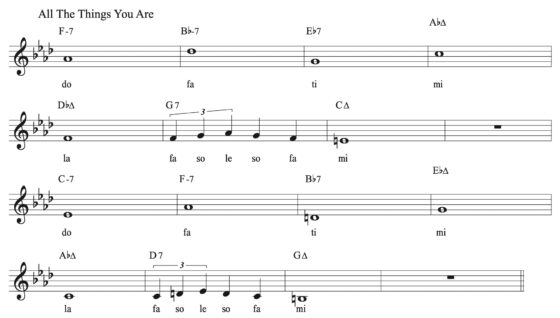
Modulations With Movable Do: “All the Things You Are”
Movable-Do shines when the tune modulates.
In “All the Things You Are”:
- Bars 1–5: Ab is Do
- Bars 6–8: C is Do
- Bars 9-13: Eb is Do
- Bars 14-16: G is Do
Every time the harmonic center changes, Do shifts with it.
This teaches your ear how to track key centers—a crucial skill for improvisation over tunes with long, functional progressions.
Movable Do in Minor Keys
Minor keys introduce two possible systems. Both are valid; each has different advantages for jazz musicians.
1. Do-Based Minor (Tonic is Do)
The tonic of the minor key is still Do.
Lowered scale degrees use:
- ♭3 → Me
- ♭6 → Le
- ♭7 → Te
Major 6 and 7 (melodic minor) use:
- 6 → La
- 7 → Ti
Advantages:
- Keeps the tonic consistent
- Useful when moving between major and minor on the same tonic
- Very clear for harmonic minor & melodic minor patterns (common in jazz)
2. La-Based Minor (Relative Minor)
Here, the minor key begins on La of the major scale.
For example:
- C major → A minor (La)
Raised tones use:
- 6 → Fi
- 7 → Si
Advantage:
- Useful when moving between relative major and minor
How the Choice Affects Modulation
Depending on the approach, the behavior of Do changes:
Do-Based Minor
- C major → C minor → Do stays C
- C major → A minor → Do becomes A
La-Based Minor
- C major → A minor → Do stays C
- C major → C minor → Do becomes Eb (or La is C)
Personally, I use both depending on the context:
- If a tune is entirely in minor, or if it is in major and goes to the parallel minor, I use the do-based minor (do re me).
- If a tune is in major and then goes to the relative minor, I use the la-based minor (la ti do). This way, the do is always the same pitch.
Examples to Practice in Minor
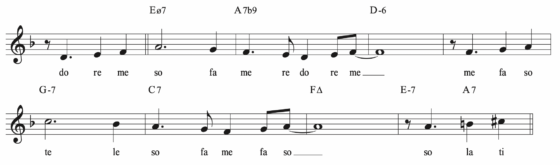
Beautiful Love
“Beautiful Love” contains shifts between minor and its modal variants (melodic, harmonic).
Movable-Do helps you understand how each altered note functions.
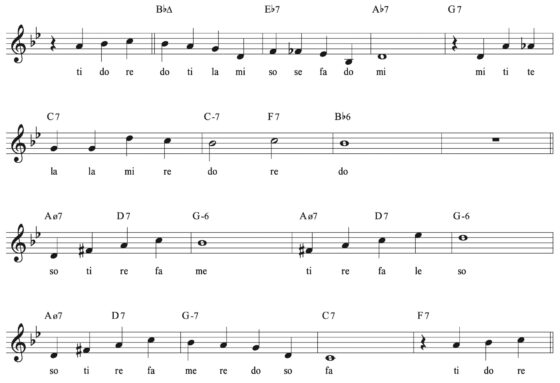
There Is No Greater Love
A great example of hearing minor ii–V–I movements using either system.
Here it is with the La-based minor:

Now here it is with the Do-based minor:
Conclusion: Why Movable Do Belongs in Your Jazz Practice
Movable-Do solfege is not just a singing exercise—it’s a complete ear training system that strengthens your understanding of harmony, melody, and tonal function.
For jazz players, it offers:
- faster transposition,
- clearer hearing of chord changes,
- stronger improvisational vocabulary,
- and a deeper “inside the key” awareness.
Add movable-Do to your daily practice, even for five minutes, and you’ll notice improvements in your ear, your phrasing, and your ability to learn tunes quickly.